
What Your Donation Platform Really Costs on a $100 Gift
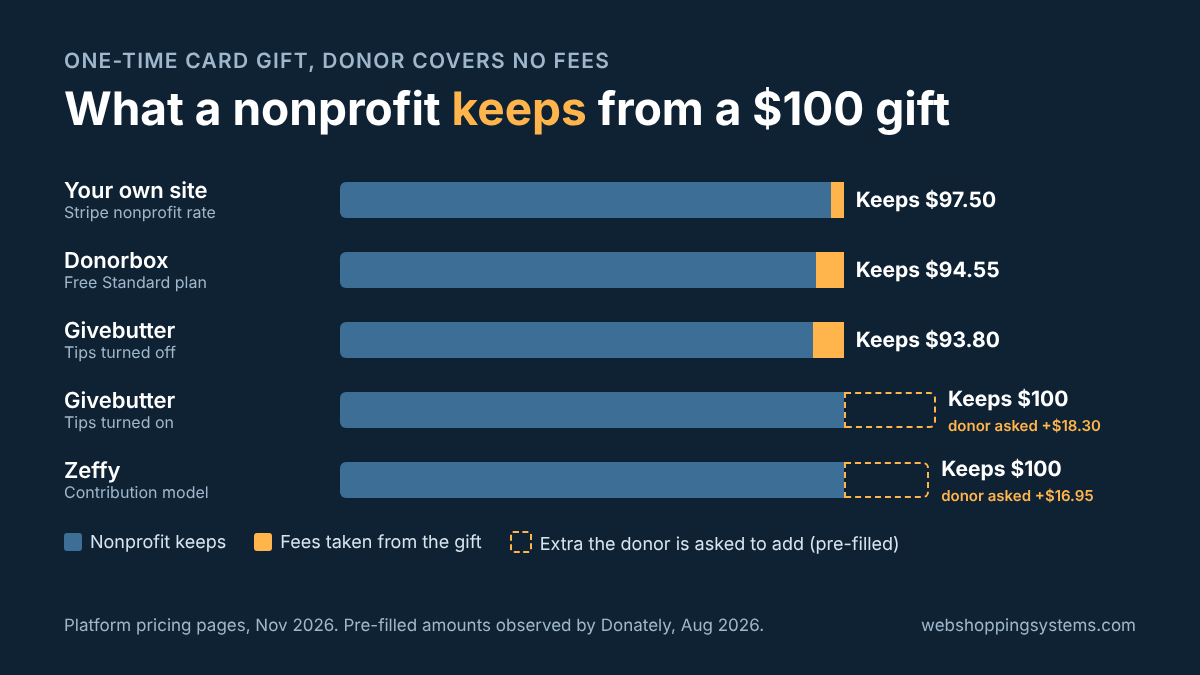
Short answer: On a $100 card gift, a nonprofit keeps about $97.50 with a donation page on its own site using Stripe's nonprofit rate, $94.55 on Donorbox's free Standard plan, and $93.80 on Givebutter with tips turned off. "Free" platforms like Zeffy, and Givebutter with tips on, pass the full $100 to the nonprofit but ask the donor to add a contribution to the platform, often pre-set around 15% or more.
Giving Tuesday is December 1. For many nonprofits it is the biggest online giving day of the year, and every gift passes through a donation platform that keeps a share or asks your donors for one.
Most nonprofits never add it up. The pricing pages talk about "no platform fees" and "100% free," and the real cost shows up in a monthly statement nobody reads, or at your donor's checkout where you never see it.
I rewrote and maintained the GiveDirect.org fundraising platform from 2012 to 2021, including its donor portals, accounting and payment processing. Here is what a $100 gift actually costs on the platforms small nonprofits use most, and what to check before Giving Tuesday.
How much does a donation platform keep from a $100 gift?
The table shows a one-time $100 card gift to a U.S. 501(c)(3) when the donor does not cover any fees. Fees were checked on each platform's pricing page in November 2026.
| Setup | Platform fee | Card processing | Nonprofit keeps | What the donor is asked to add |
|---|---|---|---|---|
| Donation page on your own site, Stripe nonprofit rate | $0 | $2.50 (2.2% + 30¢) | $97.50 | Optional fee coverage, if you offer it |
| Donorbox Standard (free plan) | $2.95 (2.95%) | $2.50 (Stripe, 2.2% + 30¢) | $94.55 | Optional fee coverage |
| Donorbox Pro ($150 a month) | $1.75 (1.75%) | $2.50 | $95.75, before the monthly fee | Optional fee coverage |
| Givebutter, tips turned off | $3.00 (3%) | $3.20 (2.9% + 30¢) | $93.80 | Optional fee coverage |
| Givebutter, tips turned on | $0 | $0 (Givebutter covers it) | $100.00 | A tip to Givebutter plus processing fees |
| Zeffy | $0 | $0 (Zeffy covers it) | $100.00 | A contribution to Zeffy |
Across a year, the gaps add up. On $50,000 raised in $100 gifts, Donorbox's Standard platform fee comes to $1,475, and Givebutter's tips-off fee comes to $1,500 plus $350 more in processing than the nonprofit rate.
Donorbox's event tickets, memberships and peer-to-peer campaigns carry a higher 3.95% fee on the Standard plan. American Express cards usually cost more to process than Visa and Mastercard.
Are "free" donation platforms really free?
They are free to the nonprofit. Someone still pays for the card processing and the software, and on these platforms it's the donor.
Zeffy says optional contributions from donors are its only source of revenue. Givebutter, with tips turned on, charges the nonprofit nothing and covers any processing fees donors decline to pay. Both ask the donor for the money at checkout, with an amount already filled in.
How big is that amount? Donately, a competing platform, checked live checkout pages for a $100 gift in August 2026. It found Zeffy pre-selecting a $16.95 contribution, and Givebutter pre-selecting a $15 tip plus $3.30 in processing fees. Donors can change or remove those amounts, so the average actually paid is lower, but neither platform publishes it.
That model works well for many small nonprofits. It's fair to know what it asks of your donors, though:
- A donor who meant to give $100 may see a total near $118 at checkout.
- The extra goes to the platform, not your mission.
- You don't set the wording or the pre-filled amount. On Givebutter you choose only whether tips are on, and on Zeffy the request is always part of checkout.
If your donors are older, on fixed incomes, or sensitive about where their money goes, that checkout screen is part of your fundraising, whether you designed it or not.
What hidden costs should a nonprofit check?
The fee on each gift is the cost you can see. These are the ones that show up later:
- Recurring donors. Monthly donors are worth more than one-time gifts, and their saved cards are the hardest thing to move. Ask: if we leave, can we take our recurring donors with us without asking each one to re-enter a card?
- Donor data. Make sure you can export every donor, every gift and every recurring schedule, whenever you want, in a standard file.
- Fees on everything else. Event tickets, memberships, auctions and peer-to-peer campaigns often carry a different fee than donations.
- Branding. Free plans often put the platform's name on your forms and receipts. Donorbox, for example, removes "Powered by Donorbox" from receipts automatically only on its paid plans.
- Monthly add-ons. Text-to-give, kiosks, extra users and CRM contact limits are often billed separately.
- The donor's trip off your site. If the donate button sends people to another website, some of them won't finish.
When should a nonprofit build its own donation page?
Not always. A new nonprofit raising a few thousand dollars a year is usually better off on a good platform. The setup is free, the forms work, and the fees are small in dollars.
Owning your donation system starts to make sense when one or more of these is true:
- Platform fees run into thousands of dollars a year. At $100,000 a year, a 2.95% platform fee is $2,950, every year, on top of processing.
- Recurring gifts are a big share of your income. You want those donors, and their payment details, in a processor account you control.
- You need it to fit how you work. Donor portals where people update their own cards, gifts that post to your accounting system, or reports your board actually asks for.
- You want donors to stay on your site. The form, the receipt and the thank-you page all carry your name and nobody else's.
A donation page on your own site connects straight to a processor like Stripe. Built the right way, card details go straight to the processor, so your server never stores card numbers. You pay the processing fee, and with Stripe's nonprofit rate that's 2.2% + 30¢.
The trade-off is the build and the upkeep. Someone has to write it, keep it secure and test it whenever the processor changes something. Payment code is not the place to cut corners, so get a firm quote and compare it with what you pay in platform fees over two or three years.
What should you check before Giving Tuesday?
- Find your real cost per $100. Add up last month's platform and processing fees and divide by what you raised.
- Offer donors the option to cover fees. Most platforms have a checkbox for it. Keep it optional and show the dollar amount.
- Apply for Stripe's nonprofit rate now if you process through your own Stripe account. You need 501(c)(3) status, and at least 80% of your Stripe volume must be tax-deductible donations. Stripe doesn't apply the discount to past payments, so every day you wait costs you.
- Make monthly giving easy. Put a monthly option right on the form, not on a separate page.
- Test a gift on your phone. Give $5 the way a donor would, then check the receipt for your legal name, EIN and the right tax wording.
- Export your donor list. Keep a current copy outside the platform before your busiest day.
- Check the checkout screen your donors see. If there's a tip or contribution request, know what it says and what amount is pre-filled.
Web Shopping Systems builds donation pages, donor portals and payment systems in core PHP, connected directly to processors like Stripe. If you'd like to know whether a donation page on your own site would pay for itself, request an estimate or call 888-508-0830. Please feel free to reach out with any questions.
Donation platform fees: frequently asked questions
What is a normal fee for online donations?
Card processing alone is about 2.2% + 30 cents per gift for a 501(c)(3) on Stripe's nonprofit rate, or 2.9% + 30 cents at Stripe's standard rate. Platforms that charge a fee add more on top: 2.95% on Donorbox's free Standard plan and 3% on Givebutter with tips turned off.
Is Zeffy really free?
Zeffy charges the nonprofit nothing and covers card processing. It is paid for by an optional contribution that donors are asked to add at checkout, so the cost moves from the nonprofit to the donors who choose to pay it.
Should I ask donors to cover processing fees?
Offering it is a good idea, as long as it stays optional and shows the dollar amount. Most platforms, and most custom donation pages, can add a checkbox that lets donors cover the fee so the nonprofit receives the full gift.
How do I get Stripe's nonprofit rate?
Apply through Stripe support with your EIN or IRS 501(c)(3) letter. At least 80% of your Stripe payment volume must come from tax-deductible donations. The discount is not applied to payments made before approval, so apply as early as you can.
When is a custom donation page worth it?
When platform fees reach thousands of dollars a year, when recurring gifts are a large share of your income, or when you need donor portals, accounting links or full ownership of your donor and payment data. Below that, a well-chosen platform is usually the better value.
About the author
Kimberly Carr has written web software in core PHP for 25 years. She rewrote and maintained the GiveDirect.org fundraising platform from 2012 to 2021, including its donor portals, accounting and payment processing, and her code for a U.S. Department of Housing and Urban Development project passed its security review on the first review. She runs Web Shopping Systems, where she builds custom PHP applications and payment systems with Claude Code and reviews every release herself.